A European glazing supplier lists a glass panel as 1.2 metres wide, and the US drawings for the opening are in inches. To convert metres to inches, divide by 0.0254: 1.2 m is 47.24 inches, 0.76 inch short of 48. Use the converter above for a quick answer, then use the planner below to compare one or more metric panels with an inch-based opening. The planner calculates converted sizes, panel gaps, available clearance and basic fit warnings. It supports early coordination only: the approved glazing system and the manufacturer's drawings must determine the final panel and opening dimensions.
Glass Panel and Opening Fit Planner
Enter the supplier's panel dimensions in metres and the measured opening in inches. For a multi-panel installation, add the quantity and the planned gap between panels. If the project already specifies a required perimeter clearance, enter it as a separate planning value. Results update as you type.
Your Panel and Opening Comparison
How the Glass Panel Planner Works
Each panel is converted with the exact relationship inches = metres ÷ 0.0254. For several panels arranged side by side, the planner adds their widths and one internal gap between each adjacent pair:
Combined width = (panel width × quantity) + (gap × (quantity − 1))
Required opening width = combined width + (2 × outer-side clearance)
Required opening height = panel height + (2 × vertical clearance)
The area result converts the metric panel area into square feet for comparison. It does not estimate glass weight, frame size, structural loading, edge cover, bite, sealant joints or thermal movement. The glazing trade's own terms for the space around a pane are edge clearance, the gap between the pane's edge and the frame that allows for tolerances and stops the glass touching the frame, and edge cover, the overlap of the frame over the glass. Both are set by the glazing system, not by a unit conversion.
The Default Example Step by Step
| Result | Value | How it is worked out |
|---|---|---|
| One panel | 47.2441 in × 78.7402 in | 1.2 m ÷ 0.0254 and 2 m ÷ 0.0254 |
| Required opening | 47.7441 in × 79.2402 in | Panel plus 0.25 in clearance on each side, above and below |
| Required opening in metres | 1.2127 m × 2.0127 m | Inches × 0.0254, for checking against a metric drawing |
| Width and height remaining | 0.2559 in × 0.7598 in | 48 in and 80 in opening, minus the requirement |
| Actual centred clearance | 0.378 in each side, 0.6299 in above and below | Half of the space left around the panel |
| Glass area | 2.4 m² · 25.833 ft² | 1.2 m × 2 m, then × 10.7639 for square feet |
The default layout meets the clearances entered, with 0.2559 inch (about 6.5 mm) of width to spare. That margin is small, which is why the original metric specification, not a rounded inch figure, should drive the order.
Metre to Inch Conversion Formula
One inch is exactly 0.0254 metres (meters in US spelling), so divide the metres by 0.0254:
in = m ÷ 0.0254
One metre is therefore about 39.3700787402 inches, so multiplying by 39.3700787402 gives the same result to within rounding. That decimal never ends, so dividing by 0.0254 is the exact method. The factor follows from the inch definition: 1 in = 0.0254 m.
To go the other way, the inches to metres converter turns an inch-based drawing dimension back into metres by multiplying by 0.0254, which is how you check an opening on US plans against a supplier's metric drawing. For example, 47.25 in comes back as 1.20015 m.
Metre to Inch Conversion Table
| Metres (m) | Inches (in) |
|---|---|
| 0.1 m | 3.93700787402 in |
| 0.5 m | 19.6850393701 in |
| 1 m | 39.3700787402 in |
| 2 m | 78.7401574803 in |
| 5 m | 196.850393701 in |
| 10 m | 393.700787402 in |
| 25 m | 984.251968504 in |
| 50 m | 1,968.50393701 in |
| 100 m | 3,937.00787402 in |
| 1,000 m | 39,370.0787402 in |
From a 1.2-Metre Glass Panel to an Inch-Based Installation Plan
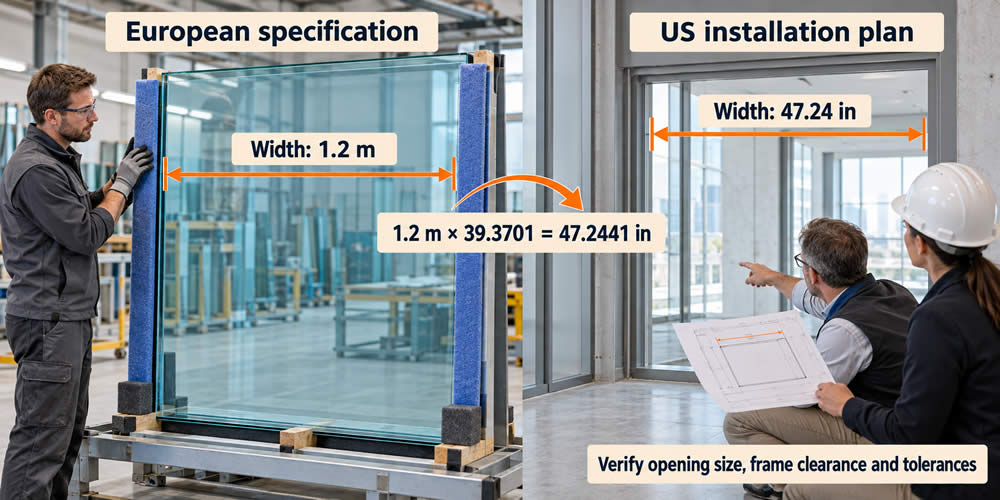
A European glass manufacturer may specify an architectural panel as 1.2 metres wide . When that panel is ordered for a project in the United States, the architect, installer or framing contractor may need the same width in inches. Converting the measurement makes it easier to compare the imported panel with inch-based drawings, openings and mounting components.
Converting the Panel Width
One metre is equal to approximately 39.3701 inches. To convert metres to inches, multiply the measurement by 39.3701 (or divide by 0.0254):
Inches = metres × 39.3701
For the 1.2-metre glass panel:
1.2 m × 39.3701 ≈ 47.2441 in
The panel is therefore approximately 47.24 inches wide. This is slightly less than 48 inches, a difference of about 0.76 inches, which is large enough to matter when a rigid glass panel must fit inside a prepared opening.
Jumbo Glass Sheets in Metres and Inches
Panels are cut from large factory sheets, and "jumbo" does not mean one size. Pilkington's glossary defines it as the largest size of glass the company supplies, for example 6000 mm by 3210 mm. A US fabricator, Glasswerks, lists its insulating glass units up to 126 in by 236 in, which is almost exactly the same sheet in inches (3.2004 m by 5.9944 m), but the same page lists annealed and laminated glass up to 130 in by 300 in, which is 3.302 m by 7.62 m and noticeably larger.
| Dimension | Metres | Inches | Quoted by |
|---|---|---|---|
| Example panel width | 1.2 m | 47.24 in | This page's example |
| Jumbo sheet width | 3.21 m | 126.38 in | Pilkington, in metres |
| Jumbo sheet length | 6 m | 236.22 in | Pilkington, in metres |
| Insulating glass unit width, maximum | 3.2004 m | 126 in | Glasswerks, in inches |
| Insulating glass unit length, maximum | 5.9944 m | 236 in | Glasswerks, in inches |
| Annealed or laminated glass width, maximum | 3.302 m | 130 in | Glasswerks, in inches |
| Annealed or laminated glass length, maximum | 7.62 m | 300 in | Glasswerks, in inches |
The comparison shows why a converted figure should be treated as a bridge between two documents. The metric and inch sizes above are not rounded versions of one another, so confirm the exact size with the supplier. See Pilkington's glossary of glass terms and Glasswerks' jumbo glass range.
Why the Conversion Matters Before Installation
Imagine that a US architect is preparing a reception-area partition using imported glass panels. The European supplier's drawing lists a panel width of 1.2 m, while the architectural plans and site measurements are recorded in inches. Converting the panel width allows the project team to express both sets of measurements in the same unit before approving the order.
The converted width must not automatically be treated as the required opening size. Glass installations can require space for frames, channels, gaskets, seals, expansion and installation tolerances. If a panel measures 47.2441 inches, the surrounding opening may need to be slightly wider, depending on the approved glazing system and manufacturer's instructions.
Rounding at the Right Stage
A catalogue might display the result as 47.24 inches, while a workshop drawing may use a more precise decimal or a practical fractional-inch measurement. For reference, 47.2441 inches is close to 47 1/4 inches, but that rounded fraction is 0.0059 inch wider than the original metric dimension. Converted back with the inches to metres converter, 47 1/4 inches is 1.20015 m, which is 0.15 mm wider than the 1.2 m specification.
For purchasing, fabrication and installation, the original 1.2 m specification should remain on the technical documents. The converted value helps the US project team understand and coordinate the measurement, but it should not replace the manufacturer's certified dimension.
Why Glass Cannot Simply Be Trimmed on Site
Annealed glass can be cut by scoring and snapping, but toughened (tempered) safety glass is made from panes that are cut to size and finished before toughening, and it cannot be cut, drilled or reworked afterwards without shattering. If the converted dimension is wrong, the fix for a toughened panel is usually a replacement, not a trim. This is why the metric value, the converted inch value and the opening size should all be checked before the glass is ordered. One UK supplier, Cantifix, explains the process.
One Panel, Two Measurement Systems
This type of conversion is common when glass, doors, partitions, façade components and other building products cross between metric and US customary markets. The physical panel does not change: 1.2 m and approximately 47.24 in describe the same width.
When you need to convert metres to inches, the calculation provides a useful bridge between an overseas product specification and an inch-based project plan. Final dimensions, tolerances and opening sizes should always be confirmed against the supplier's technical drawing before the glass is ordered or installed.
Standards and Further Reading
- NIST: SI units, length: the 1959 definition of the inch as exactly 25.4 mm, so that 1 in = 0.0254 m.
- Pilkington: glossary of glass terms: jumbo glass (6000 mm by 3210 mm), annealed glass, edge clearance and edge cover.
- Glasswerks: jumbo glass: the maximum sizes in inches for insulating, annealed, tempered and laminated glass.
- Cantifix: can you cut toughened glass?: why toughened glass must be cut to size before toughening.
The conversions, the example and the planner are AbacaDigital's own arithmetic, and the panel and opening sizes are illustrations. Figures on this page are checked against the sources listed. Spotted an error? Contact us.