Convert feet to metres and compare common shipping-container types, including standard dry, high-cube, refrigerated, open-top and flat-rack equipment. Select a container to view representative external dimensions, usable measurements, floor area and approximate capacity in metric or imperial units.
One international foot equals exactly 0.3048 metres, so a 40-foot container has an external length of exactly 12.192 m. You can also browse all length converters.
Compare Shipping Container Sizes
Select a common container type and choose how its measurements should be displayed. The guide includes dry containers, refrigerated containers, open-top equipment and flat racks.
20-Foot Standard Dry Container
A general-purpose enclosed container used for boxed, palletised and other dry cargo.
This container is approximately 6.058 m long externally and 5.900 m long internally.
Check the door opening and the specification of the actual container before planning a shipment.
Important: These are representative dimensions for comparison, taken from Hapag-Lloyd's published example specifications. Measurements, capacity, tare mass and payload can vary by manufacturer, equipment series and carrier. Flat-rack dimensions are particularly variable. Confirm every shipment against the specification and safety plate of the actual container.
Quick Feet-to-Metres Reference
| Feet | Metres | Example |
|---|---|---|
| 1 ft | 0.3048 m | Exact international foot definition |
| 8 ft | 2.4384 m | Nominal container width |
| 8.5 ft | 2.5908 m | Standard container height |
| 9.5 ft | 2.8956 m | High-cube container height |
| 19.875 ft | 6.058 m | External length of a nominal 20-foot container |
| 40 ft | 12.192 m | External length of a 40-foot container |
| 45 ft | 13.716 m | External length of a 45-foot container |
| 200 ft | 60.96 m | Five 40-foot containers before adding gaps |
A “20-Foot” Container Is Not Exactly 20 Feet Long
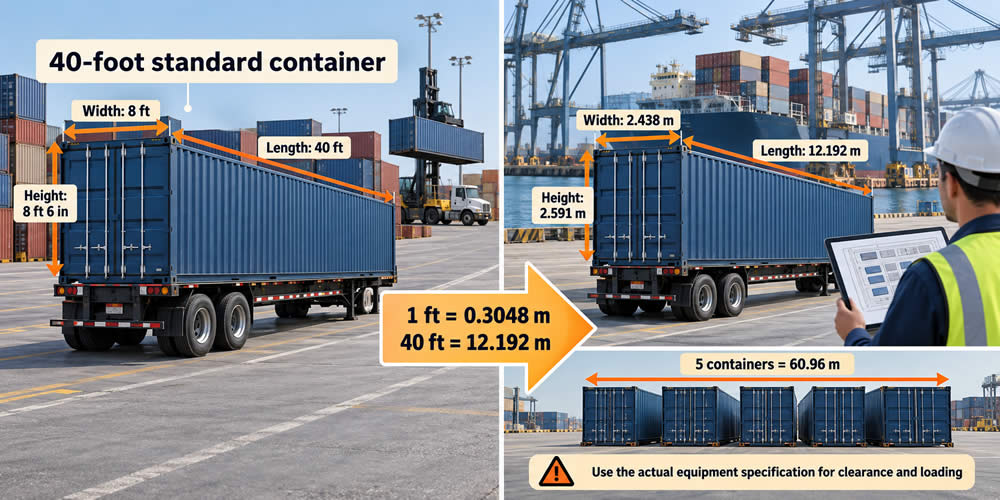
A logistics company may book a “20-foot” or “40-foot” container while an overseas port, warehouse or route-planning system records the same equipment in metres. The names look like exact dimensions, but a nominal 20-foot container is actually 6.058 m long externally.
This equals approximately 19.875 ft, making the container 0.038 m shorter than a true 20-foot measurement of 6.096 m.
The difference is deliberate. Two 20-foot containers placed end to end with a gap of approximately 0.076 m match the external length of one 40-foot container:
2 × 6.058 m + 0.076 m = 12.192 m
The 40-foot length, by contrast, is exact:
40 ft × 0.3048 = 12.192 m
The container name is therefore an equipment-class label. Loading, clearance and route planning should use published dimensions rather than relying only on the nominal name.
Converting Container Dimensions from Feet to Metres
One international foot equals exactly 0.3048 metres:
Metres = feet × 0.3048
Applying the formula to common external dimensions gives:
- 40 ft × 0.3048 = 12.192 m
- 8 ft × 0.3048 = 2.4384 m
- 8.5 ft × 0.3048 = 2.5908 m
- 9.5 ft × 0.3048 = 2.8956 m
A planning document may round these measurements to 12.19 m, 2.44 m, 2.59 m and 2.90 m. A high-cube container is one foot, or 0.3048 m, taller externally than a standard-height container.
To reverse the calculation, divide metres by 0.3048 or use the metres to feet converter.
Common Shipping Container Types
Standard Dry Containers
General-purpose dry containers are enclosed steel boxes used for cartons, pallets, manufactured products and other cargo that does not require temperature control. Common sizes include 20-foot and 40-foot standard containers.
High-Cube Containers
High-cube containers are approximately one foot taller than standard containers. The extra height increases internal capacity and can help with lightweight but bulky cargo. Common examples include 40-foot and 45-foot high-cube containers.
Refrigerated Containers
Refrigerated containers, commonly called reefers, use insulation and temperature-control equipment. These components reduce the internal space available for cargo when compared with a dry container of the same external size.
Air must circulate around temperature-controlled cargo, so usable loading space may be lower than the full geometric volume.
Open-Top Containers
Open-top containers have a removable cover and can accommodate cargo that is difficult to load through ordinary doors. They are commonly used for tall machinery, timber and other cargo loaded by crane.
Roof-opening dimensions, top rails and removable headers can limit the usable opening, so the actual equipment specification remains important.
Flat-Rack Containers
Flat racks provide a platform with end structures but no permanent side walls or roof. They are used for machinery, vehicles, pipes and oversized cargo.
Because a flat rack is not an enclosed box, it does not have a normal internal cubic capacity. Planning focuses on platform dimensions, payload, floor loading, securing points and any permitted out-of-gauge projection.
External, Internal and Door Dimensions
A container’s advertised size normally refers to its external equipment class. The usable space inside is smaller because the walls, floor, doors, corner posts and structural frame occupy part of the external dimensions.
| Container | External dimensions | Typical internal dimensions | Door opening (width × height) | Approximate capacity |
|---|---|---|---|---|
| 20 ft standard | 6.058 × 2.438 × 2.591 m | 5.900 × 2.352 × 2.395 m | 2.340 × 2.292 m | 33.2 m³ |
| 40 ft standard | 12.192 × 2.438 × 2.591 m | 12.032 × 2.352 × 2.395 m | 2.340 × 2.292 m | 67.7 m³ |
| 40 ft high cube | 12.192 × 2.438 × 2.896 m | 12.032 × 2.352 × 2.700 m | 2.340 × 2.597 m | 76.3 m³ |
| 45 ft high cube | 13.716 × 2.438 × 2.896 m | 13.556 × 2.352 × 2.700 m | 2.340 × 2.597 m | 86 m³ |
The door opening is smaller than the widest and tallest internal dimensions. Cargo can therefore fit within the theoretical interior yet still be too large to pass through the doors. In the 20-foot standard container, for example, the interior is 2.395 m high but the door opening is only 2.292 m high, a difference of 0.103 m.
Open-top equipment also has separate roof-opening dimensions, while flat racks use platform and end-frame measurements. These details should be checked in the carrier’s equipment specification.
Planning a Row of Containers
Suppose a terminal wants to place five 40-foot containers end to end. Using the converted external length:
5 × 12.192 m = 60.96 m
The containers alone occupy 60.96 m, or 200 ft. The terminal must also provide space for separation, handling equipment, safety zones and access, so multiplying the container length is only the first stage of planning a storage row.
Container capacity is counted differently. A 20-foot container is generally counted as one TEU, or twenty-foot equivalent unit, while a 40-foot container counts as two TEU. TEU is a capacity-counting unit, not a substitute for exact physical dimensions.
The Road Vehicle Is Larger Than the Container
A container moved by road sits on a chassis or trailer, so the complete vehicle is longer and may be higher than the container itself. Route planning must consider the full vehicle dimensions, legal limits, bridge clearances, turning space and axle loads.
Converting 40 ft to 12.192 m is a useful starting point, but it does not replace checks using the actual container, trailer and route. Retain the original specification alongside converted values and verify safety-critical dimensions with the carrier or equipment provider.
Sources and Measurement Notes
The container dimensions and capacities in the guide and tables come from the example specifications on Hapag-Lloyd's container equipment pages , and the ISO size and type codes can be checked in its container type guide .
Hapag-Lloyd notes that the published measurements are only examples and that containers can vary by manufacturer. Its own pages show small inconsistencies, such as an internal width of 2.350 m in one table and 2.352 m in a diagram for the 40-foot high-cube container, so treat differences of a few millimetres as normal.
This guide is intended for initial comparison and unit conversion. It does not calculate payload, axle loading, cargo securing, dangerous goods requirements, floor point loads or legal transport clearance. Figures on this page are checked against the sources above. Spotted an error? Contact us.