
To convert metres (meters in US spelling) to feet, divide by 0.3048, or multiply by about 3.28084: 20 m ÷ 0.3048 = 65.62 ft. That is the question an installer faces when metric-labelled bulk Ethernet cable arrives and the office plan is measured in feet. The answer looks comfortable on paper, a spare 11.62 ft over a 54 ft route, and the rest of the page shows why that margin is smaller than it looks. You can jump straight to the cable length calculator or browse all length converters.
Quick Metres to Feet Reference
| Metres | Feet | Where it matters |
|---|---|---|
| 1 m | 3.281 ft | The basic conversion |
| 10 m | 32.81 ft | Typical total allowance for patch cords |
| 20 m | 65.62 ft | The example cable in this article |
| 90 m | 295.28 ft | Typical limit for the permanent link |
| 100 m | 328.08 ft | Typical limit for a complete channel |
| 304.8 m | 1,000 ft | A standard US box of bulk cable |
Checking a 20-Metre Cable Against a 54-Foot Route
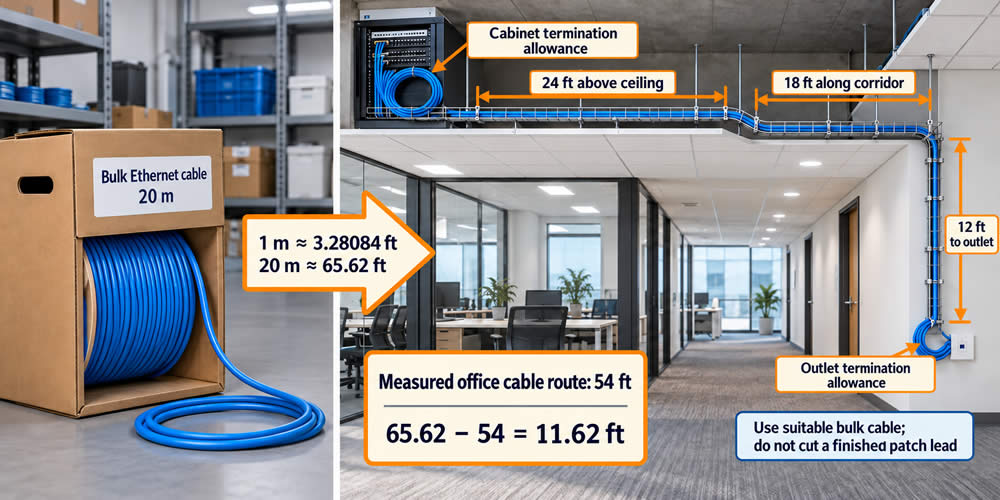
Network cable and office floor plans don't always use the same measurement system. A US engineer may receive bulk Ethernet cable labelled in metres while the office walls, ceiling routes and equipment locations are measured in feet. Converting the cable length lets the engineer compare it with the complete route before cutting or terminating anything.
ft = m ÷ 0.3048
One foot is exactly 0.3048 m, so a 20 m cable is 20 ÷ 0.3048 = 65.62 ft. A straight line between the network cabinet and the desk isn't enough, because the cable must follow an approved route. Suppose the planned pathway has three sections:
- 24 ft above the ceiling from the cabinet
- 18 ft along the office corridor
- 12 ft across and down the final wall to the outlet
24 ft + 18 ft + 12 ft = 54 ft (about 16.46 m)
65.62 ft − 54 ft = 11.62 ft (about 3.54 m) beyond the measured route.
Why Not Cut It to Exactly 54 Feet?
The route length is only the path between two points. The cable must also reach inside the cabinet, run to the patch panel or outlet, be terminated and leave some service slack for maintenance. Published guidance varies. trueCABLE suggests at least 3 ft of slack at a media enclosure and at least 0.7 ft at each outlet (1.6 ft at remote outlets), while an installation article describes a service loop of about 10 ft in the telecommunications closet. This page uses two illustrative allowances: 5 ft at the equipment end and 2 ft at the outlet, and 10 ft and 2 ft. The 2 ft at the outlet is generous compared with that guidance, so read it as a cautious allowance for routing into the box.
With the lower allowances the 54 ft route needs 54 + 5 + 2 = 61 ft. With the higher ones it needs 54 + 10 + 2 = 66 ft, which is more than the 65.62 ft available, by about 0.38 ft. So the 11.62 ft is helpful but not generous. A cable cut to the exact measured route may also come up short once it follows corners and enters boxes, so measurements should follow the real installation route rather than a straight line.
Distance Limits in Metres and Feet
Twisted-pair Ethernet has a distance limit. The usual limit for a complete channel is 100 m (328 ft), commonly planned as a permanent link of up to 90 m (295 ft) plus patch cords totalling up to 10 m (33 ft), as in the TIA-568 structured-cabling standard. Shorter cords or other cable types can change the exact allowance. Legrand's data sheets, for example, list a permanent link of 89 m or less for some cord arrangements, so check the product specification. The 20 m example is comfortably inside the limit, so length isn't the constraint here, but slack is.
Boxes and Markings: Which Unit Is the Cable In?
US bulk Ethernet cable is typically sold in 1,000 ft boxes, which listings often label as 305 m. The exact figure is 304.8 m, so the label rounds up by 0.2 m. Many reels also have sequential length markings on the jacket, for example every two feet. Imported cable may be marked in metres instead.
The unit of the markings matters. A mark of 20 on a metre-marked cable means 20 m, which is 65.6 ft, while the same mark on a foot-marked cable means 20 ft. Reading metre marks as feet makes a run look about 3.3 times shorter than it is, and reading foot marks as metres makes it look about 3.3 times longer. Check which unit the jacket uses before cutting.
Round the Safe Way
Using 3.3 ft per metre as a shortcut overstates the cable. 20 m × 3.3 = 66 ft, which is 0.38 ft more than the real 65.62 ft, enough to turn a marginal run into one that comes up short. When checking the supply, round the cable length down, and when measuring a route, round it up.
Bulk Cable, Patch Cables and Suitability
This example assumes bulk installation cable that is meant to be cut and terminated. A factory-made 20 m patch cable already fitted with connectors shouldn't normally be shortened by cutting it, because that removes a tested connector and may invalidate its performance or warranty. If a shorter patch lead is needed, buy one in the required length.
Length also doesn't show that a cable is suitable. The installer should check the category and speed needed, solid or stranded conductors, shielding, the indoor, riser or plenum rating, compatibility with jacks and patch panels, and building and telecommunications rules. The cable should be supported by proper pathways, kept apart from power wiring, and protected from sharp edges and excess pulling force. A common guideline for unshielded twisted-pair cable is a minimum bend radius of four times the cable's diameter, and the completed link should be tested with appropriate equipment.
To go the other way, multiply feet by 0.3048, or use the feet to metres converter. It works through a case where the surprise is the opposite one: a "20-foot" shipping container that isn't 20 feet long.
Cable Length Calculator: Will Your Cable Reach?
Enter the cable length in metres and the sections of your route in feet. This cable length calculator adds the route, adds slack at both ends, converts everything with 1 ft = 0.3048 m, and shows whether the cable fits and by how much. It is meant for network cable runs, so it does not size wires or work out voltage drop. The slack allowances are illustrative and editable, because published guidance varies.
A Worked Example
| Allowance | Route plus slack | Needed | The 20 m cable (65.62 ft) |
|---|---|---|---|
| Route only | 54 ft | 54 ft (16.46 m) | Spare 11.62 ft (3.54 m) |
| Low slack: 5 ft and 2 ft | 54 + 5 + 2 = 61 ft | 61 ft (18.59 m) | Spare 4.62 ft (1.41 m) |
| High slack: 10 ft and 2 ft | 54 + 10 + 2 = 66 ft | 66 ft (20.12 m) | Short by 0.38 ft (0.12 m) |
The same cable fits or falls short depending only on how much slack you allow. The calculator does not check the cable's category, rating or suitability, and the usual 90 m permanent-link limit depends on the cable and equipment specification.
Sources
- Legrand technical data sheet S000118333EN-00 (Cat. 6 cords): cords of up to 10 m in total and the 100 m two-connector channel, with maximum permanent link lengths that depend on the cord arrangement.
- trueCABLE: service loops: slack guidance at media enclosures, outlets and in the telecommunications room.
- Cabling Installation & Maintenance: S-shaped service loop: a service loop of about 10 ft above the distribution frame.
The 90 m permanent link and 10 m cord allowance follow the TIA-568 structured-cabling standard. Figures on this page are checked against the sources above. Spotted an error? Contact us.