Convert US automotive component dimensions from inches to metres, then use the planner to add protective clearance and estimate whether rectangular parts can fit inside a metric shipping crate. The worked 36-inch component example shows why conversion, packaging space and orientation should be considered together.
Inch to Metre Conversion Formula
One international inch is exactly 0.0254 metres (meters in US spelling):
1 in = 0.0254 m
To convert inches to metres, multiply by 0.0254:
m = in × 0.0254
The factor is exact. The NIST guide to SI length units explains that the international inch has equalled exactly 25.4 mm since 1959. If your source measurement is already metric, use the metres to inches converter for metric product dimensions and US specifications .
Inch to Metre Conversion Table
| Inches (in) | Metres (m) |
|---|---|
| 0.1 in | 0.00254 m |
| 0.5 in | 0.0127 m |
| 1 in | 0.0254 m |
| 2 in | 0.0508 m |
| 5 in | 0.127 m |
| 10 in | 0.254 m |
| 25 in | 0.635 m |
| 50 in | 1.27 m |
| 100 in | 2.54 m |
| 1,000 in | 25.4 m |
Worked Example: A 36-Inch Component Prepared for a Metric Market
Consider an illustrative supply-chain example. A US supplier records a rectangular automotive trim component in inches, but an overseas distributor needs metres for its catalogue, warehouse system and packaging brief. The physical part does not change; only the way its dimensions are communicated changes.
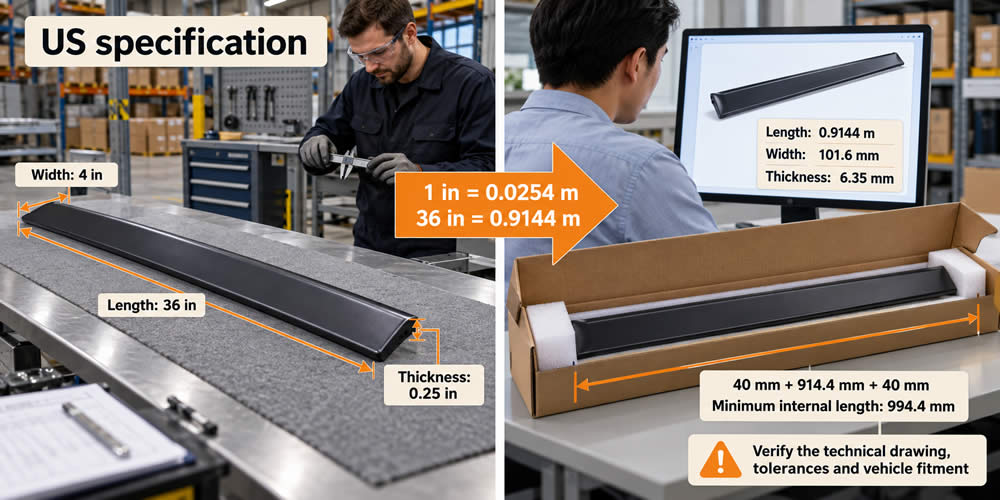
Converting inches to metres allows both companies to describe the same component consistently without altering its physical size.
Car Sizes That Already Mix Inches and Metric Units
Vehicle specifications often place metric and customary measurements side by side. A 4.5-inch wheel bolt-circle diameter converts to 0.1143 m, while a common tyre description can combine width in millimetres, an aspect ratio and a rim diameter in inches. These figures describe different features, so conversion helps comparison but does not establish compatibility.
| Dimension | Inches | Metres |
|---|---|---|
| Wheel bolt circle | 4.5 in | 0.1143 m |
| Rim diameter (17-inch wheel) | 17 in | 0.4318 m |
| Tyre width (example) | 8.86 in | 0.225 m |
| Sidewall height (45% of the width) | 3.99 in | 0.10125 m |
| Overall tyre diameter (rim + two sidewalls) | 24.97 in | 0.6343 m |
The overall diameter comes from 0.4318 m + 2 × 0.10125 m = 0.6343 m, or about 24.97 inches.
The US Specification Lists 36 Inches
Imagine a US supplier producing a generic automotive trim or protective rail measuring 36 inches long. The engineering drawing, packaging label and domestic product record all use inches.
An overseas distributor serving a metric market wants to list the component in metres. One international inch equals exactly 0.0254 metres, so the conversion is:
36 in × 0.0254 = 0.9144 m
The component is exactly 0.9144 metres long. A retailer may display this as approximately 0.914 m or 0.91 m, depending on the precision appropriate for the product listing.
Why the Number of Decimal Places Matters
Rounding 0.9144 m to 0.91 m makes the value easier to read, but it changes the displayed length by 0.0044 m. That may be acceptable in a general catalogue description but unsuitable for a fitment drawing.
A sensible product record might therefore show both values:
Length: 36 in (0.9144 m)
The original dimension remains visible, while the exact metric equivalent helps overseas engineers and customers interpret the part.
Converting the Complete Component Size
Suppose the product specification also gives a width of 4 inches and a thickness of 0.25 inches. Each dimension should be converted separately:
4 in × 0.0254 = 0.1016 m
0.25 in × 0.0254 = 0.00635 m
The complete metric description becomes:
- Length: 0.9144 m
- Width: 0.1016 m
- Thickness: 0.00635 m
Checking the Shipping Package
The part may be 0.9144 m long, but its shipping carton must be longer to accommodate padding and end protection. Suppose the distributor allows 0.04 m of protective space at each end:
0.04 m + 0.9144 m + 0.04 m = 0.9944 m
The minimum internal carton length is therefore approximately 0.9944 m. A nominal one-metre carton may appear sufficient, but its actual internal dimensions should be checked before packaging is ordered.
Conversion Does Not Confirm Vehicle Fitment
Two components can share the same 36-inch length and still be completely incompatible. Vehicle fitment may depend on mounting-hole positions, curvature, material, model year and left- or right-hand orientation.
The distributor should retain the manufacturer's part number and technical drawing rather than treating the converted length as proof that the product fits a particular vehicle.
Nominal Size, Tolerance and Measurement Method
A component advertised as 36 inches may have an allowed manufacturing tolerance. The supplier may measure between its outer ends, mounting points or another defined reference. The overseas listing should use the same reference points.
For technical or safety-related parts, the exact drawing, tolerance and applicable automotive requirements take priority over a rounded online description.
Preparing the Part for a Metric Market
When you convert inches to metres, multiply the inch value by exactly 0.0254. A 36-inch automotive component becomes 0.9144 metres, allowing it to be entered into a metric catalogue, packaging plan or warehouse system.
Showing both units can reduce confusion across the supply chain: 36 in = 0.9144 m. The conversion communicates the length clearly, while the original drawing remains the authority for manufacturing and fitment.
Automotive Component and Shipping Crate Planner
Enter one rectangular component in inches, the number of components being shipped and the crate's internal dimensions in metres. The planner converts the part into metres, adds clearance on every face and tests all six axis-aligned orientations to find the strongest simple packing result.
Planning estimate
How to Use the Crate Estimate
Clearance is added to both sides of every dimension. For example, 20 mm of clearance adds 40 mm to the component's overall length, 40 mm to its width and 40 mm to its height. The planner then rotates the protected rectangular shape through every length-width-height arrangement and reports the orientation holding the greatest number of whole components.
This is an early planning estimate, not a certified packing design. It assumes rigid rectangular envelopes arranged in a straight grid. It does not account for irregular shapes, interlocking parts, dividers, pallets, crate-wall thickness, load distribution, stacking limits, centre of gravity or transport regulations. Confirm the final plan against the manufacturer's drawing and the crate supplier's verified internal dimensions.
Source and Methodology
The length conversion uses the exact international relationship 1 inch = 0.0254 metres, documented by the National Institute of Standards and Technology . All automotive dimensions in the story are explanatory examples rather than fitment recommendations for a particular vehicle or product.
The crate planner converts each entered dimension independently, adds the selected clearance to both faces, and checks six axis-aligned orientations. Its capacity result is a geometric estimate and should be verified against technical drawings, packaging requirements and the crate's measured internal dimensions before use.