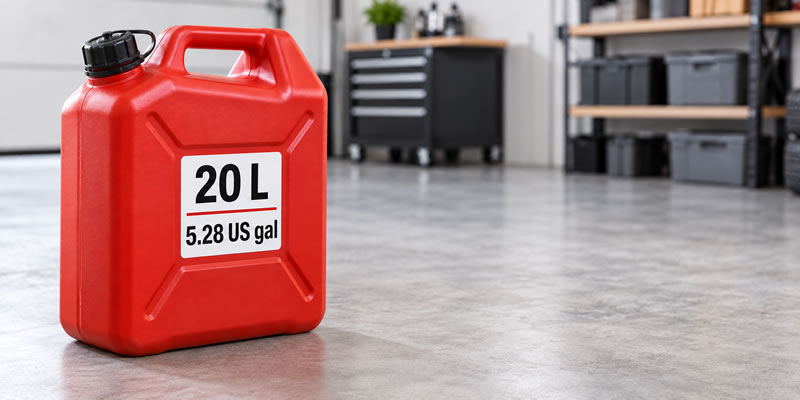
Use this Liters to US Gallons Converter for fuel cans, vehicle tanks, pools, brewing vessels and other liquid capacities. A 20-liter fuel can provides a practical example because its capacity equals approximately 5.28 US gallons. Explore other units through our volume converters.
Why Are Fuel Cans Marked in Both Liters and Gallons?
A portable fuel can may be manufactured in one measurement system and used with equipment described in another. For example, a can might be labelled 20 L, while a vehicle manual, generator specification or fuel-pump display refers to US gallons.
A 20-liter container holds approximately 5.28 US gallons. Both values describe the same internal capacity; only the unit has changed.
Converting a 20-Liter Fuel Can to US Gallons
One US liquid gallon contains exactly 3.785411784 liters. To convert liters to US gallons, divide the volume in liters by 3.785411784:
US gallons = liters ÷ 3.785411784
You can also multiply the number of liters by the equivalent conversion factor:
US gallons = liters × 0.2641720524
For a 20-liter fuel can, the calculation is:
20 ÷ 3.785411784 ≈ 5.28344 US gal
Rounded to two decimal places, the can holds 5.28 US gallons. A product label may show fewer decimal places because the complete calculated value is unnecessary for everyday use.
The conversion relationship is documented in NIST Handbook 130 , which lists one liter as approximately 0.2641720524 US gallon.
Common Capacities in Liters and US Gallons
The same calculation can be applied to small fuel bottles, vehicle tanks, aquariums, rainwater containers and large storage tanks.
| Liters (L) | US gallons (US gal) | Possible use |
|---|---|---|
| 1 L | 0.264 US gal | Small fuel or drinks bottle |
| 2 L | 0.528 US gal | Small liquid container |
| 5 L | 1.321 US gal | Lawn equipment or emergency fuel |
| 10 L | 2.642 US gal | Portable equipment fuel |
| 15 L | 3.963 US gal | Vehicle or machinery reserve |
| 20 L | 5.283 US gal | Traditional full-size jerry-can capacity |
| 25 L | 6.604 US gal | Large portable container |
| 40 L | 10.567 US gal | Fuel purchase or small tank |
| 50 L | 13.209 US gal | Passenger-vehicle fuel tank |
| 100 L | 26.417 US gal | Aquarium or storage container |
| 200 L | 52.834 US gal | Water barrel or storage tank |
| 500 L | 132.086 US gal | Large domestic storage tank |
| 1,000 L | 264.172 US gal | Industrial or rainwater tank |
These figures represent mathematical conversions. Actual usable capacity may be lower because of a container’s shape, fittings, fill line or the empty space required for safe use.
If your original measurement is in US gallons, use the US gallons to liters converter for the reverse calculation.
Why the 20-Liter Jerry Can Became Familiar
The traditional jerry can became well known as a strong portable container with a rectangular body and multiple carrying handles. Its shape made cans easier to stack, transport and pass between people during loading and unloading.
The classic design was associated with a capacity of approximately 20 liters, although modern containers inspired by it are manufactured in several sizes. The Australian War Memorial describes a preserved military example as a 20-liter pressed-steel petrol jerry can.
The term “jerry can” is now sometimes used broadly for many portable fuel containers. The name alone therefore does not guarantee a 20-liter capacity. Users should check the marked volume and the manufacturer’s instructions.
Why Manufacturers Print Both Units
Fuel cans, vehicles and powered equipment are traded internationally. Liters are familiar in metric markets, while US gallons remain common in the United States. Printing both measurements helps customers compare a container with a vehicle tank, equipment manual or purchase limit without first performing a separate calculation.
Dual-unit labelling can also make stock easier to identify. A supplier may describe a container as holding 20 liters, while a customer searches for a can of roughly five gallons. Displaying both units indicates that the products fall within the same general capacity range.
Does “Gallon” Mean US or Imperial Gallon?
A Liters to US Gallons Converter must distinguish between the US liquid gallon and the imperial gallon because they represent different volumes:
- 1 US liquid gallon = 3.785411784 liters
- 1 imperial gallon = 4.54609 liters
The same 20-liter fuel can therefore holds approximately:
- 5.28 US gallons; or
- 4.40 imperial gallons.
NIST lists these as separate units in its tables of capacity and volume units . If a label displays only “gal,” check the intended market or product documentation to determine which definition applies.
Using the Conversion for Fuel Planning
Drivers may convert liters to US gallons when comparing a metric fuel can with a vehicle handbook, estimating how much of a tank can be refilled or comparing fuel purchases between countries.
For example, a 50-liter vehicle tank has a nominal capacity of:
50 ÷ 3.785411784 ≈ 13.21 US gal
A 20-liter can would contain enough fuel to fill approximately 40 percent of that nominal tank capacity:
20 L ÷ 50 L × 100 = 40%
This is a capacity comparison only. It does not account for fuel already in the tank, unusable container volume or the space that may need to remain empty for safe handling and expansion.
Always use an approved fuel container and follow its marked capacity, filling instructions, transport requirements and safety warnings.
Liters to US Gallons for Tanks, Pools and Brewing
Liters-to-US-gallons conversion is useful wherever a container and its instructions use different measurement systems. For storage tanks, it helps users compare supplier specifications. Pool owners may need it when treatment directions are written for US gallons but the pool’s capacity is known in liters.
Brewers may use the conversion to compare recipe quantities, fermenter capacities and batch sizes. Aquarium owners may also convert a metric tank volume when filters or treatments are rated in US gallons.
Conversion provides a common basis for comparison, but instructions involving fuel, water treatments, brewing ingredients or aquarium products should still be followed according to their labels. Using the wrong gallon definition can create a significant error, particularly for large volumes.