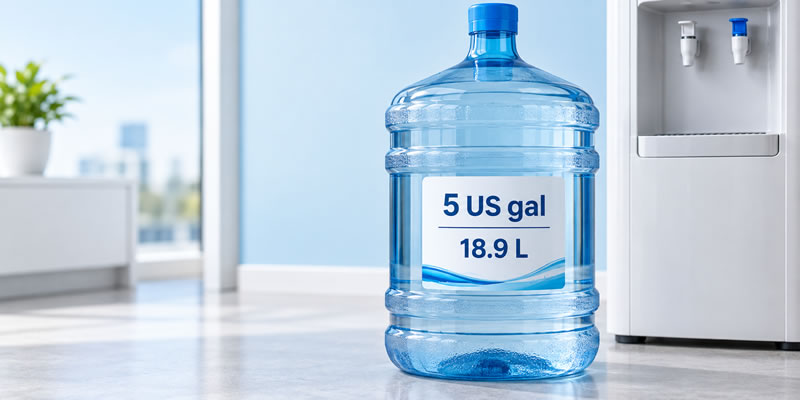
Use this US Gallons to Liters Converter for water bottles, fuel tanks, aquariums and other liquid capacities. The five-gallon water-cooler bottle provides a familiar example: its metric label normally reads approximately 18.9 liters. Explore additional units through our volume converters.
Why Are Water-Cooler Bottles Labelled in Gallons and Liters?
A refillable water-cooler bottle is a practical example of converting US gallons to liters. A large bottle may carry markings such as 5 US gal and 18.9 L. These values describe approximately the same capacity in two different measurement systems.
Dual-unit labels are helpful because bottles, dispensers and delivery equipment may be manufactured in one country and used in another. A customer familiar with gallons can recognise the traditional container size, while someone who uses metric measurements can compare it with other products labelled in liters.
How Five US Gallons Becomes 18.9 Liters
One US liquid gallon contains exactly 3.785411784 liters. To convert US gallons to liters, multiply the gallon value by this conversion factor:
Liters = US gallons × 3.785411784
For a water-cooler bottle described as holding five US gallons:
5 × 3.785411784 = 18.92705892 L
A manufacturer does not normally need to print every decimal place on the bottle. Rounding the result to one decimal place produces 18.9 L. This is why “5 US gallons” and “18.9 liters” commonly appear together on the same type of container.
The exact US-gallon conversion factor is documented in the NIST Guide to SI conversion factors .
Common US Gallon Capacities in Liters
The same calculation applies to small containers, aquariums, fuel tanks and larger water-storage systems. The table below places common values beside their metric equivalents.
| US gallons (US gal) | Liters (L) | Possible use |
|---|---|---|
| 1 US gal | 3.785 L | Small liquid container |
| 2 US gal | 7.571 L | Portable water container |
| 3 US gal | 11.356 L | Small drinks or water dispenser |
| 4 US gal | 15.142 L | Household storage container |
| 5 US gal | 18.927 L | Water-cooler bottle |
| 10 US gal | 37.854 L | Small aquarium |
| 15 US gal | 56.781 L | Brewing or liquid-storage vessel |
| 20 US gal | 75.708 L | Vehicle fuel tank |
| 25 US gal | 94.635 L | Large aquarium or storage tank |
| 50 US gal | 189.271 L | Water or rainwater container |
| 100 US gal | 378.541 L | Large storage tank |
| 250 US gal | 946.353 L | Rainwater tank |
| 500 US gal | 1,892.706 L | Commercial water storage |
| 1,000 US gal | 3,785.412 L | Large industrial tank |
These are mathematical conversions. A product may use a rounded or nominal capacity, and its actual usable volume can differ because of its shape, fittings, fill line or required empty space.
If your original measurement is in liters, use the liters to gallons converter for the reverse calculation.
One Bottle for Different Markets
Gallons remain familiar in the United States, while liters are the everyday volume unit in much of the world. Printing both values allows one bottle design to communicate its capacity to customers, delivery companies and equipment suppliers across different markets.
A second unit can also prevent confusion when equipment and refills are described differently. For example, a dispenser may be advertised for 18.9-liter containers while its replacement bottles are listed as holding five US gallons. A US Gallons to Liters Converter confirms that the two product descriptions refer to approximately the same capacity.
Check Which Gallon the Label Uses
The word gallon does not always identify a single volume. One US liquid gallon equals exactly 3.785411784 liters, while one imperial gallon equals exactly 4.54609 liters. The imperial gallon is therefore noticeably larger.
Five imperial gallons would equal:
5 × 4.54609 = 22.73045 L
A bottle marked 5 gal / 18.9 L is therefore using US liquid gallons, not imperial gallons. Treating it as five imperial gallons would produce a difference of approximately 3.8 liters.
NIST lists US and imperial gallons as separate units in its tables of capacity and volume units .
Estimating Workplace Water Use
The conversion can help an office estimate its water consumption. If employees use four five-US-gallon bottles each week, the total volume is:
4 × 5 × 3.785411784 ≈ 75.7 L per week
This figure can help with delivery planning, storage and comparisons between bottled-water suppliers. Actual consumption may vary, and partially used containers should be considered separately.
US Gallons to Liters for Fuel, Aquariums and Storage
Gallon-to-liter conversion is useful beyond water-cooler bottles. Drivers may need to compare a vehicle’s fuel-tank capacity with fuel sold by the liter. Households can use the conversion when selecting rainwater tanks or emergency water containers.
Aquarium owners may also need to convert a nominal US-gallon capacity when selecting filters, pumps or water treatments labelled in liters. The amount of water actually held by an aquarium is normally lower than its nominal capacity after gravel, decorations and equipment are added.
For every application, identify the gallon definition before calculating. The difference between a US gallon and an imperial gallon becomes increasingly significant as the container or tank becomes larger.