Why does a country whose supermarkets and pharmacies already use litres and milligrams still give the weather in Fahrenheit? NIST describes the United States as a hybrid system in which customary and metric units are both used routinely, and Fahrenheit survives mostly where people read temperatures at home: the forecast, the thermostat, the oven and the thermometer. To convert a Fahrenheit temperature, subtract 32 and multiply by 5/9, so 77 °F is (77 − 32) × 5/9 = 25 °C. The charts below cover those everyday places, and the later sections explain why the scale stayed and why both scales read −40 at the same point. Explore more units through our temperature converters.
Common Fahrenheit and Celsius Temperature Charts
Temperature conversion appears in very different settings. A number that describes outdoor weather should not be interpreted in the same way as an oven setting, refrigerator temperature, thermostat setting or body temperature. The five charts below follow the everyday places where Americans meet Fahrenheit, with the Celsius equivalent beside each familiar number.
Weather Temperature Chart
These descriptions are broad everyday references. Wind, humidity, direct sunshine, altitude, clothing and activity can make conditions feel warmer or colder than the measured air temperature.
| Fahrenheit | Celsius | General weather description |
|---|---|---|
| −40 °F | −40 °C | Extreme cold; both scales show the same number |
| 0 °F | −17.8 °C | Severe winter cold |
| 32 °F | 0 °C | Water's familiar freezing reference |
| 41 °F | 5 °C | Cold |
| 50 °F | 10 °C | Cool |
| 59 °F | 15 °C | Mild to cool |
| 68 °F | 20 °C | Mild |
| 77 °F | 25 °C | Warm |
| 86 °F | 30 °C | Hot |
| 95 °F | 35 °C | Very hot |
| 104 °F | 40 °C | Extreme heat |
Oven Temperature Chart
American recipes commonly give oven settings in Fahrenheit, while ovens and recipes in many other countries use Celsius. Converted values are normally rounded to settings an oven can display, and the rounding conventions vary between recipe books.
| Fahrenheit | Exact Celsius conversion | Common rounded setting | General description |
|---|---|---|---|
| 250 °F | 121.1 °C | 120 °C | Very low oven |
| 275 °F | 135 °C | 135 °C | Low oven |
| 300 °F | 148.9 °C | 150 °C | Low to moderate |
| 325 °F | 162.8 °C | 160–165 °C | Moderately low |
| 350 °F | 176.7 °C | 175–180 °C | Moderate oven |
| 375 °F | 190.6 °C | 190 °C | Moderately hot |
| 400 °F | 204.4 °C | 200–205 °C | Hot oven |
| 425 °F | 218.3 °C | 220 °C | Hot oven |
| 450 °F | 232.2 °C | 230 °C | Very hot oven |
| 475 °F | 246.1 °C | 245–250 °C | Very hot oven |
These are conventional-oven references. Fan-assisted ovens may require a different setting, and real appliances can run above or below the displayed temperature. Follow the recipe and appliance instructions.
Home Heating and Cooling Temperature Chart
Thermostat choices depend on season, building design, energy prices, humidity, clothing and the needs of the occupants. These entries are comparison points rather than universal recommendations.
| Fahrenheit | Celsius | Possible context |
|---|---|---|
| 60 °F | 15.6 °C | Cool indoor temperature |
| 64 °F | 17.8 °C | Cool heating setting |
| 68 °F | 20 °C | Commonly cited winter reference while awake, lower when asleep or away |
| 70 °F | 21.1 °C | Common comfortable-room reference |
| 72 °F | 22.2 °C | Warmer indoor setting |
| 75 °F | 23.9 °C | Warm indoor temperature |
| 78 °F | 25.6 °C | Commonly cited summer reference while at home, warmer when away |
| 120 °F | 48.9 °C | Water-heater setting that the U.S. Department of Energy describes as safe for most of the population |
Earlier U.S. Department of Energy and ENERGY STAR consumer guidance often cited 68 °F for winter waking hours and 78 °F for summer while at home. The current DOE Energy Saver Guide (July 2022) gives the principle without a single number: in summer, set the thermostat as high as is comfortable when you are home and awake and raise it when you are asleep or away, and in the fall and winter turning it down 7 to 10 °F for eight hours a day can save up to 10% a year. A household should account for health, age, local weather and current official guidance rather than treating these examples as mandatory settings.
Food Storage and Safe Cooking Temperature Chart
Food storage temperatures and minimum internal cooking temperatures serve different purposes. Check an appliance with an appliance thermometer and cooked food with a food thermometer.
| Fahrenheit | Celsius | Food-safety use |
|---|---|---|
| 0 °F or below | −18 °C or below | Freezer setting |
| 40 °F or below | 4 °C or below | Refrigerator setting |
| 145 °F | 63 °C | Whole cuts of beef, pork, veal and lamb, followed by a 3-minute rest |
| 160 °F | 71 °C | Ground meat and sausage |
| 165 °F | 74 °C | Poultry, casseroles and reheated leftovers |
The DOE's energy-saving advice for refrigerators, 35 to 38 °F (1.7 to 3.3 °C), sits inside the FDA's 40 °F limit. Requirements differ by food and jurisdiction. Always follow the product instructions and current local food-safety guidance; colour, texture and cooking time alone cannot confirm a safe internal temperature.
Body Temperature Chart
Normal body temperature varies between people and changes during the day. Readings also differ according to the thermometer and measurement site. The values below are conversion references, not diagnoses.
| Fahrenheit | Celsius | Context |
|---|---|---|
| 96.8 °F | 36 °C | A possible reading within normal individual variation |
| 98.6 °F | 37 °C | Traditional average reference, not an exact universal normal |
| 100.4 °F | 38 °C | NHS threshold usually considered a high temperature in adults |
| 102.2 °F | 39 °C | Higher fever reading |
| 104 °F | 40 °C | Very high reading requiring prompt attention to symptoms and guidance |
Seek medical advice based on symptoms and local guidance, not only the converted number. Different advice applies to babies, children, pregnancy, older adults and people with certain health conditions. Contact urgent or emergency services when severe symptoms are present.
How Fahrenheit Remained Part of Everyday American Life
The United States has not rejected metric measurement. It has been legal to use the metric system in the country since 1866, and NIST says metric is the nation's preferred system for trade and commerce. Litres, grams, milligrams and degrees Celsius already appear in American science, healthcare, manufacturing, food labelling and consumer products. Nevertheless, Fahrenheit remains the temperature scale that many Americans meet in forecasts, thermostats and kitchens.
Its continued use is largely a matter of continuity. Fahrenheit was already embedded in household appliances, printed recipes, building controls and public weather reporting before national metric-conversion programmes were seriously considered. Generations therefore learned to associate familiar Fahrenheit numbers with everyday conditions. A forecast in the seventies may immediately suggest mild or warm weather to an American audience, just as someone accustomed to Celsius understands the difference between 20 °C and 30 °C without performing a calculation.
The United States Uses a Mixture of Measurement Systems
Describing the United States as a country that does not use metric measurements is misleading. NIST describes the system as a hybrid in which both U.S. customary and metric measurements are used routinely. In the grocery store, people commonly meet a mix of millilitres, litres, grams, kilograms, quarts, pints and pounds, while a visit to the doctor mostly involves SI units. The preferred unit depends on the activity, industry, regulation and intended audience.
NIST explains this mixed approach in its overview of metric adoption in the United States. It also notes that metrication in the United States is voluntary, and suggests small steps such as switching a smartphone weather app from Fahrenheit to Celsius.
What the Metric Conversion Act of 1975 Changed
Congress passed the Metric Conversion Act of 1975 to establish a national policy supporting greater metric use and to create the United States Metric Board. Crucially, the transition was voluntary rather than a compulsory change imposed on households and businesses.
The law did not require weather services, appliance manufacturers or the public to abandon Fahrenheit by a particular date. Familiar customary measurements could therefore remain in everyday use while metric units became more common in scientific and commercial work. The original legislation is available as Public Law 94-168. Current US policy is summarised by the NIST Metric Program.
Where Americans Commonly Encounter Fahrenheit
Fahrenheit remains especially visible in consumer-facing situations, which is why the charts above are organised the way they are:
- television, mobile and online weather forecasts and weather warnings (the weather chart);
- domestic oven controls and American recipes (the oven chart);
- home heating and air-conditioning thermostats and water heaters (the home chart);
- refrigerators, freezers and food thermometers (the food chart);
- discussions of body temperature and fever (the body chart); and
- swimming-pool and spa temperatures.
These uses reinforce one another. Forecasts remain understandable because audiences already recognise Fahrenheit values, while regular exposure allows another generation to learn the same reference points.
Celsius Is Also Used in the United States
American laboratories and scientific publications commonly use Celsius. Engineering, manufacturing and healthcare may use SI measurements, customary measurements or both, and clinical devices and technical documents may provide selectable or parallel readings. Phones, weather services and digital thermometers frequently let users choose their preferred scale, so an American researcher may work in Celsius and check an evening forecast in Fahrenheit without treating those choices as contradictory.
This coexistence is why conversion remains useful. International travel, overseas forecasts, imported appliances, scientific information and recipes written for another country may all require a change between Fahrenheit and Celsius.
How to Convert Fahrenheit to Celsius
Conversion becomes necessary when an American temperature must be used in a country, publication or appliance that works in Celsius. The scales have different zero points and differently sized degrees, so changing only the unit symbol would produce an incorrect result.
First subtract 32 from the Fahrenheit temperature. Then multiply the result by 5/9:
°C = (°F − 32) × 5 ÷ 9
For example, suppose an American forecast reports a temperature of 77 °F:
(77 − 32) × 5 ÷ 9 = 25 °C
Therefore, 77 °F equals 25 °C. The charts above apply the same calculation to the temperatures people meet most often. If your original value is in Celsius, use the Celsius to Fahrenheit converter instead.
The One Temperature Where Fahrenheit and Celsius Match
Fahrenheit and Celsius normally assign different numbers to the same physical temperature. There is one exact exception:
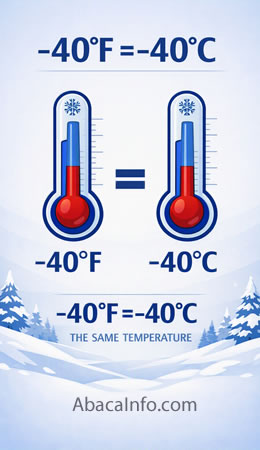
−40 °F = −40 °C
This is not a rounded coincidence. Minus 40 is the only temperature at which both scales display the same numerical value.
Why Do the Scales Meet at −40?
The Celsius-to-Fahrenheit relationship can be written as:
°F = (°C × 9 ÷ 5) + 32
Let x represent a value that is identical on both scales:
x = (x × 9 ÷ 5) + 32
Solving the equation gives:
x = −40
The result can be checked directly:
(−40 − 32) × 5 ÷ 9 = −40 °C
The relationship between the scales is linear. Because the two lines have different slopes, they can intersect only once, so there is no second temperature at which their numerical readings match.
A Useful Conversion Check
The crossover offers a convenient way to test a conversion formula or software tool. Entering −40 should return −40 whether the calculation runs from Fahrenheit to Celsius or in the opposite direction. It also shows how the relationship changes:
- Above −40, the Fahrenheit number is higher than the Celsius number.
- At −40, the two numerical values are identical.
- Below −40, the Fahrenheit number is lower than the Celsius number.
Minus 40 Is Severe Cold
Although the crossover is mathematically interesting, −40 represents dangerous cold. Health risk depends on more than the measured air temperature because wind can remove heat rapidly from exposed skin. Wind chill describes how cold exposed skin feels and does not make objects colder than the air temperature.
Environment and Climate Change Canada classifies wind-chill values from −40 to −47 as presenting a very high risk of frostbite. Under those conditions, exposed skin can freeze in about five to ten minutes, and in sustained winds over 50 km/h frostbite can occur faster than that. The actual time depends on wind, clothing, moisture, activity and individual health. See the Government of Canada's wind chill and Wind Chill Index guidance for protective advice and further information.
Extremely low temperatures can also reduce battery performance, thicken vehicle fluids and affect materials and equipment. Engineers testing products for cold environments may therefore encounter specifications near the point where Fahrenheit and Celsius share the same number.
Sources
- U.S. Food and Drug Administration: refrigerator and freezer temperatures
- FoodSafety.gov: safe minimum internal temperatures
- U.S. Department of Energy: Energy Saver Guide (July 2022): thermostat advice, refrigerator range of 35 to 38 °F and the 120 °F water-heater setting.
- NHS: high temperature in adults
- NIST: the reason the U.S. doesn't use the metric system and the NIST Metric Program
- Public Law 94-168, the Metric Conversion Act of 1975
- Government of Canada: wind chill and the Wind Chill Index
The charts are reference tables, not advice. Safety-sensitive values for food, heating and body temperature should be checked against current official guidance. Figures on this page are checked against the sources listed. Spotted an error? Contact us.