Use this Kilograms to Pounds Converter to compare airline baggage limits, check suitcase weights and interpret international shipping or food labels. A dual-unit luggage scale makes these comparisons easier by displaying the same mass in kilograms or pounds. Explore other units through our weight converters.
Why Do Luggage Scales Display Kilograms and Pounds?
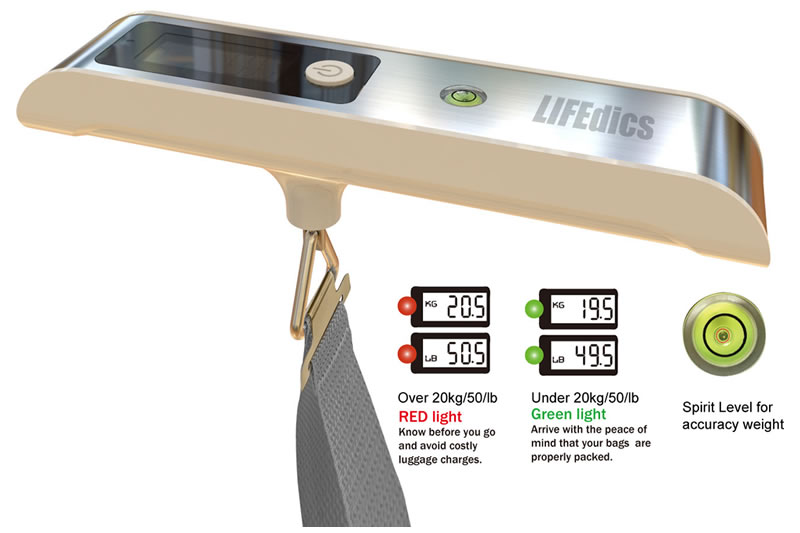
International travel brings two measurement systems into the same airport. An airline may state its baggage allowance in kilograms, while a passenger is accustomed to pounds. A dual-unit luggage scale solves this problem by showing the bag’s mass in either kg or lb.
An analogue scale may print both sets of numbers around one dial. Digital models normally provide a button that changes the displayed unit. Switching from kilograms to pounds does not change the suitcase or its mass; it only changes the numerical description shown on the screen.
Why Baggage Allowances Use Different Units
Kilograms are commonly used for baggage policies outside the United States, while pounds remain familiar to many American travellers. Airlines serving international routes may display both units, but passengers should follow the exact unit and limit printed on their own booking.
The International Air Transport Association explains that baggage allowances vary by airline and route. It identifies 23 kg as a commonly referenced checked-bag weight and notes that 32 kg is the maximum permitted mass for one checked bag in many regions. These figures are industry guidance, not a universal allowance applying to every ticket. See the IATA passenger baggage guidance .
How to Convert Kilograms to Pounds
The international avoirdupois pound is defined as exactly 0.45359237 kilograms. Its reciprocal means that one kilogram is approximately 2.20462262 pounds:
1 kg ≈ 2.20462262 lb
To convert kilograms to pounds, multiply the kilogram value by 2.20462262:
Pounds = kilograms × 2.20462262
For example, an airline baggage allowance of 23 kg converts as follows:
23 kg × 2.20462262 ≈ 50.71 lb
A traveller who usually thinks in pounds can therefore understand 23 kg as approximately 50.7 lb. When the booking states its limit in kilograms, however, it is safer to set the luggage scale to kilograms rather than rely on a rounded equivalent.
The exact pound-to-kilogram relationship is documented in the NIST Guide to SI conversion factors .
Common Luggage Weights in Kilograms and Pounds
The table below places common luggage weights beside their calculated pound equivalents. The examples illustrate possible uses rather than guaranteed baggage allowances.
| Kilograms (kg) | Pounds (lb) | Possible example |
|---|---|---|
| 0.5 kg | 1.10 lb | Small personal item |
| 1 kg | 2.20 lb | Compact travel accessory |
| 2 kg | 4.41 lb | Small packed item |
| 5 kg | 11.02 lb | Light travel bag |
| 7 kg | 15.43 lb | Light cabin bag |
| 10 kg | 22.05 lb | Cabin bag or small suitcase |
| 15 kg | 33.07 lb | Medium suitcase |
| 20 kg | 44.09 lb | Checked suitcase |
| 23 kg | 50.71 lb | Commonly referenced checked-bag limit |
| 25 kg | 55.12 lb | Large checked suitcase |
| 32 kg | 70.55 lb | Heavy individual checked item |
| 50 kg | 110.23 lb | Large parcel or freight item |
| 75 kg | 165.35 lb | Heavy freight shipment |
| 100 kg | 220.46 lb | Commercial freight |
The permitted number, dimensions and mass of bags can depend on the airline, route, aircraft, cabin, fare and loyalty status. Always check the current conditions attached to the ticket.
If the original measurement is in pounds, use the pounds to kilograms converter for the reverse calculation.
Why 23 kg Is Not Exactly 50 lb
Airline information sometimes presents 23 kg and 50 lb together as convenient equivalents. Mathematically, however, they are not the same:
- 23 kg ≈ 50.71 lb
- 50 lb ≈ 22.68 kg
The difference is approximately 0.32 kg, or 0.71 lb. If a booking specifically states a limit of 50 lb, a suitcase weighing exactly 23 kg could be over that stated limit.
Travellers should therefore use the unit printed on the booking rather than assuming that rounded kilogram and pound limits are interchangeable.
Checking a Suitcase Before the Flight
The check-in scale provides the airline’s final measurement. Discovering an overweight suitcase at the airport can result in repacking, checking another bag or paying an excess-baggage charge. A portable scale allows the traveller to check the bag at home and again before the return journey.
For the clearest comparison, set the personal scale to the unit printed on the reservation. If the allowance is 23 kg, weigh the suitcase in kilograms. If the limit is 50 lb, select pounds.
Leaving a small margin can also be sensible because household luggage scales and airport equipment may display slightly different readings. Holding a hand scale at an angle, moving the bag or weighing it on an uneven surface can affect the result.
A Quick Mental Estimate
Doubling a kilogram value gives a quick pound estimate, but the result is slightly low. A closer shortcut is to double the kilogram value and then add approximately 10 percent.
For a 20 kg suitcase:
20 × 2 = 40; add 10% ≈ 44 lb
The exact conversion is approximately 44.09 lb, so the shortcut is useful for general understanding. Use the full conversion or a Kilograms to Pounds Converter when checking a strict baggage or shipping limit.
Kilograms to Pounds for Food and Package Weights
Kilogram-to-pound conversion is also useful when food labels, bulk ingredients and parcels use an unfamiliar measurement system. A supplier may sell an ingredient by the kilogram while an American recipe specifies pounds.
For example, a 5 kg bag of flour weighs approximately:
5 kg × 2.20462262 ≈ 11.02 lb
International deliveries provide another common use. A household scale may show a parcel’s mass in kilograms while a US-based customer, marketplace or shipping document refers to pounds.
When preparing a shipment, weigh the complete parcel—including the product, box, padding, tape and labels. Carriers may apply their own rounding rules or charge according to dimensional weight, so converting the physical mass alone may not determine the final shipping price.
Food packaging can use a different convention. A product’s net weight normally excludes its packaging, whereas a parcel’s shipping weight generally includes everything being transported.