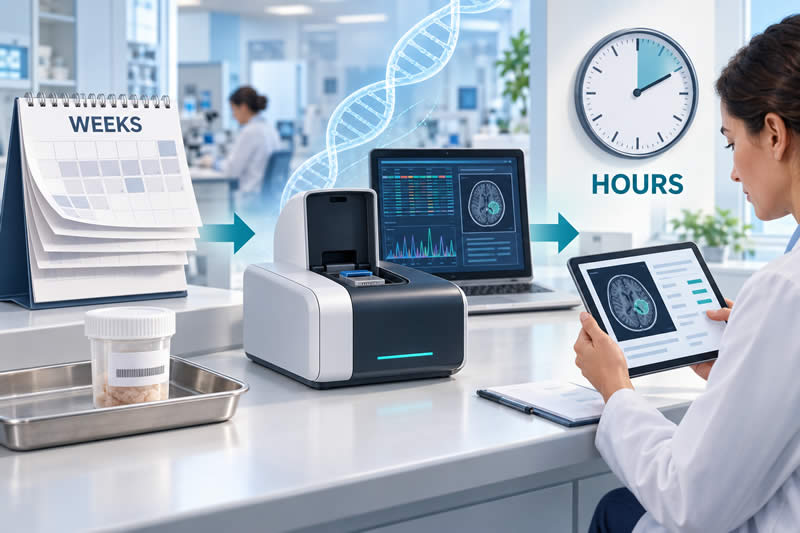
In September 2026 the NHS announced a pilot of a test that can classify a brain tumour in as little as two hours. The University of Nottingham, where the test was developed, says that compares with 26 days under current methods. Converted to hours, that is 624 hours against 2.
To convert weeks to hours, multiply by 168: one week is 7 × 24 = 168 hours. The rest of this page uses the pilot to show how weeks and hours describe the same quantity at very different scales, then shows why elapsed hours are not the same as the hours a team can actually work. For other units, browse all time converters. If your starting value is already in hours, use the hours to weeks converter.
From Weeks to Hours: The Rapid Brain Tumour Test
On 25 September 2026, NHS England announced that a pilot of a rapid genomic test for brain tumours would be extended across specialist centres in England. The first phase covers five sites in Birmingham, Nottingham, London (Great Ormond Street Hospital and King's College Hospital) and Newcastle, and NHS England is investing more than £2 million over two years in the network behind it.
The test analyses the DNA in a small sample taken during a biopsy or an operation. It uses nanopore sequencing together with analysis software called ROBIN, and was developed by scientists and doctors at the University of Nottingham and Nottingham University Hospitals NHS Trust.
Two Different Numbers: Two Hours and 26 Days
In a recent operation at Nottingham, NHS England reports that the sequencing itself took around 20 minutes and an early result reached the surgical team less than two hours after the sample arrived at the laboratory, while surgery was still under way. A fuller molecular diagnosis followed within days.
The standard route involves scans and a tumour sample examined under a microscope in a pathology laboratory, which NHS England says can take weeks to identify the type of tumour definitively. The University of Nottingham says the new approach can cut the time to classify a tumour from 26 days to as little as two hours. Individual waits vary.
The two figures measure different things. Two hours is an early classification during surgery. NHS England describes a definitive diagnosis in days rather than weeks. Doctors still need scans, pathology findings and specialist discussion, so the test is meant to give clinical teams useful information sooner, not to replace the wider diagnostic process.
Why Both Weeks and Hours Appear
Weeks describe the whole pathway clearly. Hours suit a short laboratory process. Putting them in the same unit makes the scale of the difference visible: 26 days is 624 hours, and two hours is about 0.3% of that. The comparison shows the size of the change in one step of care, not a promise about any patient's wait.
How to Convert Weeks to Hours
One standard elapsed week contains seven days, with 24 hours in each day:
1 week = 7 × 24 = 168 hours
Multiply a duration in weeks by 168:
Hours = weeks × 168
The University's 26 days is not a whole number of weeks, so convert days to hours first (1 day = 24 hours), then to weeks if you need them:
26 days × 24 = 624 hours
624 ÷ 168 ≈ 3.7143 weeks, or 3 weeks and 5 days
3.7143 weeks × 168 = 624 hours
| Weeks | Elapsed hours | Context |
|---|---|---|
| 1 week | 168 hours | One complete week of elapsed time |
| 2 weeks | 336 hours | A fortnight |
| 3.7143 weeks (26 days) | 624 hours | The University of Nottingham's figure for classifying a tumour under current methods |
| 4 weeks | 672 hours | Four weeks |
| 6 weeks | 1,008 hours | An illustrative longer wait |
| 8 weeks | 1,344 hours | An extended investigation or project phase |
| 12 weeks | 2,016 hours | About one quarter of a year |
| 26 weeks | 4,368 hours | About half a year |
| 52 weeks | 8,736 hours | 52 weeks is 364 days, so a 365-day year has 8,760 hours |
These are elapsed hours, so they include nights, weekends and other inactive periods.
From a Wait to a Workload: Elapsed Time Versus Effort
A wait of 26 days is 624 elapsed hours, but elapsed hours are not working hours. They include nights, weekends and time when a sample or a case is simply waiting for the next step. The hours of work inside a wait depend on how many people are involved and how much time each of them can give.
Take a made-up laboratory team, not data from the NHS or any hospital: three people, each able to give 25 hours a week to this work, with 80% of that time available once other commitments are taken out. Over 26 days, which is 3.7143 weeks:
3 people × 25 hours = 75 staff-hours a week
75 × 3.7143 weeks = 278.57 staff-hours at most
278.57 × 80% = 222.86 effective staff-hours
If each task needs 4 hours of hands-on work, that leaves room for 55 whole tasks (222.86 ÷ 4 = 55.7). The 624 elapsed hours contain 222.86 hours of effective work in this example.
That is why a faster result and a smaller workload are different things. The pilot is about how long a classification takes to arrive. How many hours of work each case needs, and how many people are available, are separate questions that this page does not answer. The units are the same, but the quantities differ: elapsed time describes the calendar, and staff-hours describe effort. The planner below lets you try your own numbers.
Elapsed Time and Team Capacity Planner
Enter a duration and a team. The planner converts the duration to elapsed hours, then works out how many staff-hours the team can give and, if you enter the hours each task needs, how many whole tasks that allows. The first example loaded is the made-up team above. The second button loads six weeks with five people.
Capacity
This is a planning illustration. It does not describe any hospital or laboratory, predict a waiting time, or allow for different workloads, task dependencies, training or staffing changes. It uses continuous elapsed time, where 1 week = 168 hours and 1 day = 24 hours, and a staff-week of 40 hours for comparison only.
Sources
- NHS East Genomics: NHS pilots rapid genomic test to transform brain tumour diagnosis (25 September 2026): the pilot, the five first-phase sites, the under-two-hour result during surgery, the 20-minute sequencing and the "days rather than weeks" diagnosis.
- NHS England announcement: the original release.
- University of Nottingham: the 26-day figure and the ROBIN software.
- Newcastle University: the nanopore sequencing and ROBIN description.
The team capacity planner and the made-up laboratory example are AbacaDigital's own illustrations based on the inputs you supply. They are not sourced from or endorsed by the organisations above. Figures on this page are checked against the sources listed. Spotted an error? Contact us.