Is a 25-Year or 30-Year Mortgage Cheaper Overall in the UK?
A lower monthly mortgage payment can make a home feel more manageable, but it does not automatically make the borrowing cheaper. With the same loan amount, interest rate and fee assumptions, a 25‑year repayment mortgage costs less overall than a 30‑year term when you follow the scheduled payments. The longer term spreads the cost across more months, keeping the debt in place for longer.
When comparing mortgage terms, consider three figures together: the monthly payment, the total interest paid and the outstanding balance over time.
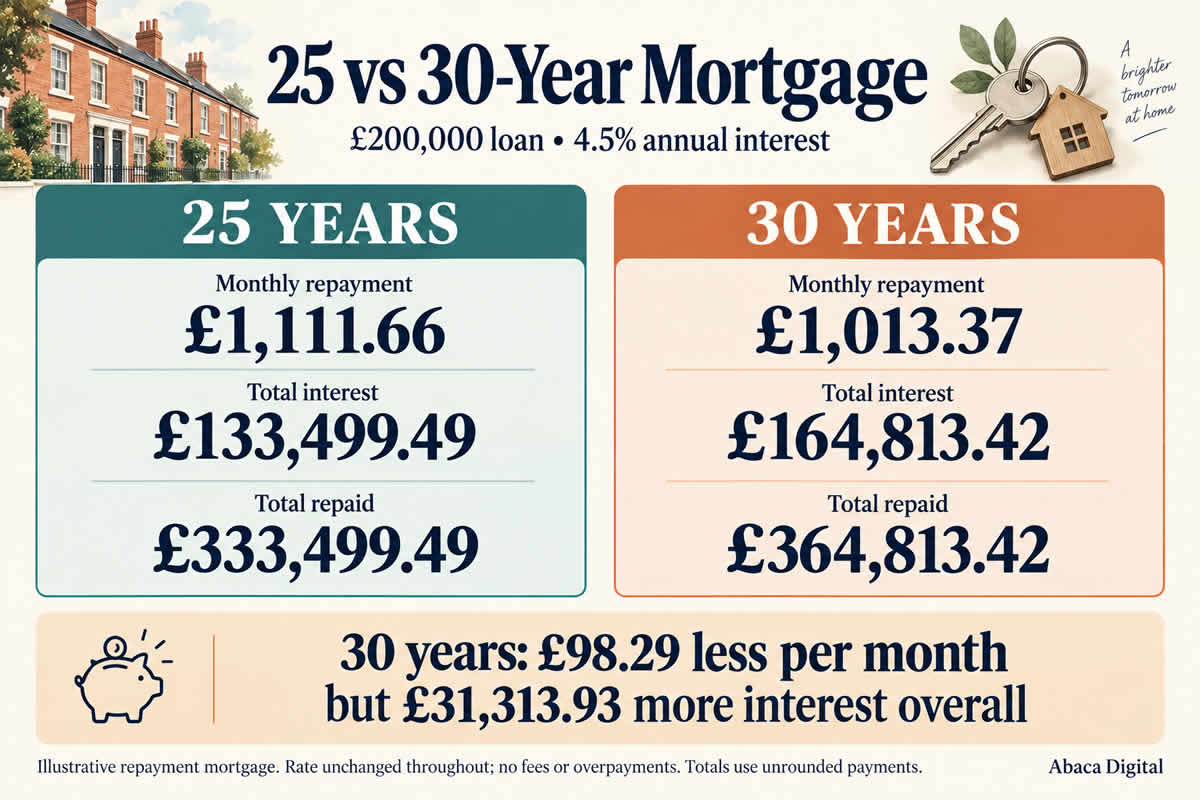
A £200,000 mortgage: 25 years versus 30 years
This example uses a £200,000 repayment mortgage with an illustrative annual interest rate of 4.5%. It is a calculation scenario, not a current mortgage offer.
| Measure | 25-year mortgage | 30-year mortgage |
|---|---|---|
| Monthly repayment | £1,111.66 | £1,013.37 |
| Total interest | £133,499.49 | £164,813.42 |
| Total mortgage repayments | £333,499.49 | £364,813.42 |
| Balance after five years | £175,715.81 | £182,315.83 |
The 30‑year term reduces the monthly payment by approximately £98.29, but increases total interest by around £31,313.93.
These figures use the standard repayment formula with monthly interest calculated as the annual rate divided by 12. They assume an unchanged rate, payments at month‑end, no fees and no overpayments. Totals use unrounded payments. Lenders may use daily interest and different rounding rules.
Here, “cheaper overall” refers to the total amount paid over the full term. The comparison does not adjust for inflation or alternative uses of the monthly payment difference.
What the balance after five years shows
You do not need to wait until the end of the mortgage to see the effect of a longer term. In this example, the borrower on the 30‑year schedule still owes about £6,600 more after five years.
Their lower monthly payments free up roughly £5,897 over five years, but their debt falls by less. The difference reflects additional interest charged during that period.
This matters if you expect to sell or remortgage before the term ends. Compare outstanding balances as well as payments made. With the same property value, a smaller balance means more equity.
Why extending the term increases interest
Each repayment covers interest and reduces the capital owed. At the start of this example, one month’s interest is £750 under either term.
The 25‑year payment reduces the balance by about £361.66 in the first month. The 30‑year payment reduces it by around £263.37. Because the longer term clears capital more slowly, interest continues to be charged on a larger balance.
MoneyHelper’s guide to longer mortgage terms explains the same trade‑off between lower monthly payments and higher lifetime interest.
The UK distinction: mortgage term versus fixed-rate deal
A 30‑year mortgage term does not guarantee a fixed interest rate for 30 years. The term describes the planned repayment period; the initial rate deal may last only part of it.
For example, a five‑year fixed‑rate deal could sit within either a 25‑year or a 30‑year mortgage. When the deal ends, the rate may change depending on the product and whether you arrange a new deal.
The full‑term interest figures above isolate the effect of choosing a longer term. They are not forecasts of future UK mortgage rates. For an explanation of fixed, tracker and variable rates, see MoneyHelper’s mortgage interest‑rate guide .
Can overpayments make a 30-year mortgage behave like 25 years?
Under the example’s assumptions, paying about £98.29 extra each month on the 30‑year mortgage would match the 25‑year payment. If the rate, payment timing and overpayment rules were identical, this would produce a similar repayment timeline and interest cost.
This approach offers a lower contractual payment, but the shorter schedule depends on making the extra payments consistently. Occasional overpayments may not achieve the same result.
Before overpaying, check your mortgage’s allowance, any early repayment charges and how your lender applies additional payments. MoneyHelper explains these considerations in its mortgage overpayment guidance .
Check whether remortgaging extends your repayment date
After five years of a 30‑year mortgage, the scheduled remaining term is normally 25 years. Replacing it with a new 30‑year mortgage moves the planned repayment date five years further away.
The new payment may look attractive partly because you have added more repayment months. To see what a new interest rate actually changes, compare deals over the same remaining term first, including fees and charges. Consider term extensions separately.
See MoneyHelper’s guide to comparing remortgage deals for further points to check.
Compare the two terms using your own figures
Use our UK mortgage calculator to compare a 25‑year and 30‑year repayment schedule. Keep the loan amount and interest rate unchanged initially to isolate the effect of the term alone.
- Calculate the monthly payment and total interest over 25 years.
- Change the term to 30 years and note the difference.
- Repeat with a higher illustrative rate to see how borrowing costs change.
- Check both payments against household bills, other debts, home maintenance and your savings buffer.
This article covers capital‑and‑interest repayment mortgages. Interest‑only borrowing requires a separate comparison because regular interest payments do not reduce the original loan balance.
A 25‑year term reduces scheduled interest costs, while a 30‑year term reduces the required monthly payment. Consider both figures rather than assuming the lowest payment is the cheapest mortgage.