How Does a 1% Interest Rate Increase Affect Monthly Mortgage Payments?
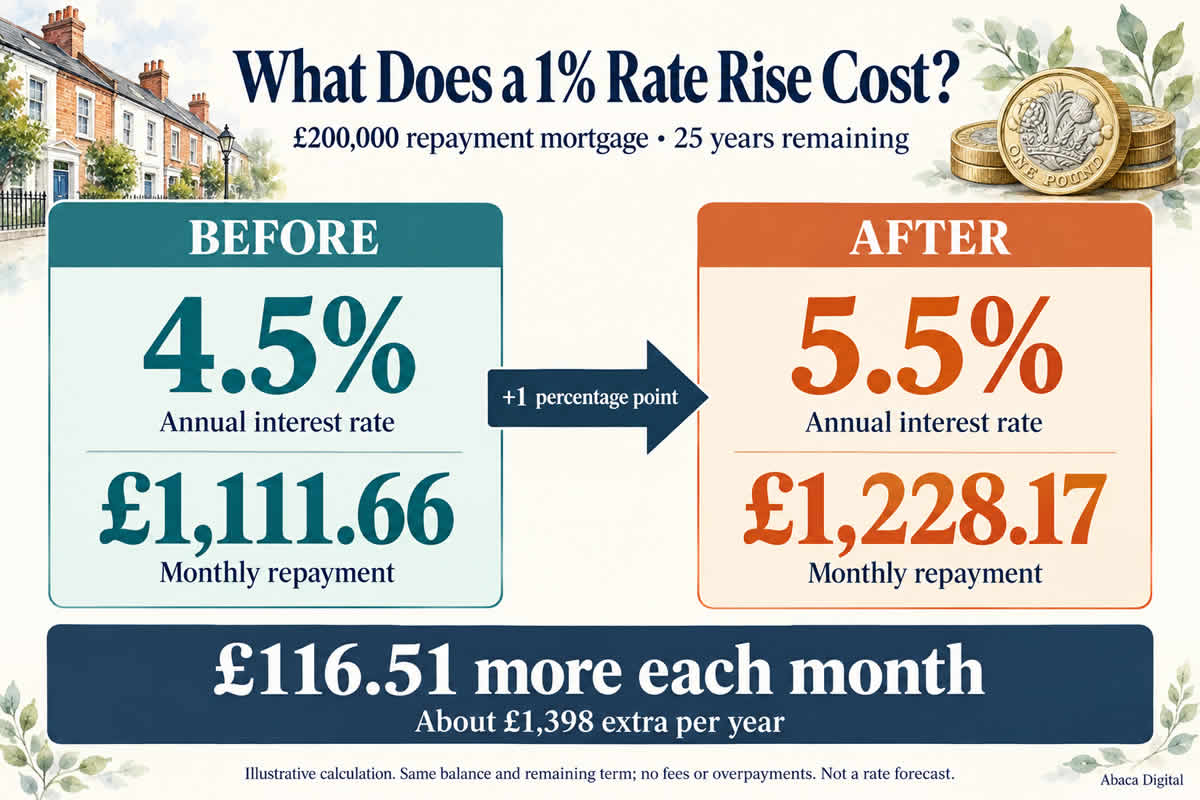
A one‑percentage‑point rise in your mortgage rate can increase your monthly payment by considerably more than 1%. For example, on a £200,000 repayment mortgage with 25 years remaining, moving from 4.5% to 5.5% raises the estimated payment from £1,111.66 to £1,228.17.
That is approximately £116.51 more each month, or about £1,398 over a year if the higher payment applies throughout those 12 months. Your own change depends on your outstanding balance, remaining term and mortgage type.
A 1% rate rise is not a 1% payment increase
In everyday mortgage discussions, a “1% rate rise” usually means an increase of one percentage point. For example, a rate of 4.5% becomes 5.5%.
This differs from increasing 4.5% by 1% of its value, which would produce 4.545%. The calculations in this article use the one‑percentage‑point interpretation.
In the £200,000 example, the monthly repayment rises by roughly 10.5%. There is no single percentage that applies to every mortgage because the starting rate and remaining term both influence the result.
How the effect varies with different remaining terms
Here is how a move from 4.5% to 5.5% changes the monthly repayment on the same £200,000 balance.
| Remaining term | At 4.5% | At 5.5% | Monthly increase |
|---|---|---|---|
| 15 years | £1,529.99 | £1,634.17 | £104.18 |
| 20 years | £1,265.30 | £1,375.77 | £110.47 |
| 25 years | £1,111.66 | £1,228.17 | £116.51 |
| 30 years | £1,013.37 | £1,135.58 | £122.21 |
These examples assume capital‑and‑interest repayments, payments at month‑end, monthly interest calculated as the annual rate divided by 12, and no fees or overpayments. Each payment is calculated as if its rate continued for the remaining term. The rates are illustrative, not current offers or forecasts.
Monthly increases are based on rounded payments. Your lender’s figures may differ due to daily interest calculations, payment dates or rounding.
The 30‑year schedule has the lowest payment at both rates, yet the largest pound increase. Extending a mortgage reduces the monthly commitment but does not remove sensitivity to interest‑rate changes.
Use your current balance, not your original loan
A rate change applies to the borrowing still outstanding. If you originally borrowed £250,000 but now owe £210,000, use £210,000 when estimating your revised payment.
The remaining term matters too. Five years into a 25‑year mortgage, you would normally calculate the new payment over the 20 years left, assuming you have followed the original schedule.
For identical rates and remaining terms, the payment difference scales with the loan balance. A £100,000 mortgage would experience roughly half the increase shown for £200,000. Changing the term or starting rate requires a fresh calculation.
Why multiplying your balance by 1% can mislead
A common shortcut is to multiply the balance by 1% and divide by 12. For £200,000, that produces £166.67. This estimates the extra monthly interest on an unchanged balance, not the change in a repayment mortgage’s full monthly payment.
A repayment mortgage combines interest with capital repayment. When the rate changes, the payment is recalculated to clear the outstanding balance over the remaining term.
In the first month of the 25‑year example, interest rises from £750 to about £916.67. Meanwhile, the capital repaid falls from around £361.66 to £311.50. The monthly payment therefore rises by less than the increase in that month’s interest.
This explains why your payment increases even though a smaller portion initially goes towards reducing the balance.
When UK mortgage payments actually change
A Bank of England base‑rate announcement does not change every mortgage payment. The effect depends on your agreement with your lender.
- Fixed‑rate mortgage: your fixed rate stays unchanged during the fixed period. A higher rate may affect your payment when the deal ends.
- Tracker mortgage: your rate follows the benchmark named in your agreement, often the Bank of England base rate. Timing and limits depend on product terms.
- Standard variable rate: the lender sets the rate. It may not follow a base‑rate change by the same amount or on the same day.
Check your mortgage offer and your lender’s payment‑change notice rather than assuming a headline rate rise applies directly to you. MoneyHelper explains these products in its mortgage interest‑rate guide .
What changes for an interest‑only mortgage?
For a fully interest‑only mortgage, the regular payment covers interest without reducing the original capital. The balance‑times‑rate shortcut is therefore a useful monthly estimate.
On an unchanged £200,000 balance, increasing the rate from 4.5% to 5.5% raises the estimated monthly interest from £750 to £916.67 — an increase of about £166.67.
The £200,000 still needs to be repaid through your agreed strategy. Actual interest payments can vary with the lender’s calculation method and payment period.
Check your payment with a mortgage calculator
To estimate the effect on your own repayment mortgage, use our UK mortgage calculator . Comparing two rates with the same balance and remaining term helps you isolate the cost of the rate increase.
- Enter your outstanding balance and the years and months left.
- Calculate the monthly payment at your current rate.
- Add one percentage point to that rate and calculate again.
- Subtract the first result from the second to find the estimated monthly increase.
If the tool asks for a property price and deposit, ensure the resulting mortgage amount equals the balance you want to test.
Keep optional housing costs unchanged during this comparison. Council tax, insurance and service charges affect your budget but are separate from the interest‑rate calculation.
Avoid confusing a lower payment with a cheaper deal
When comparing a replacement mortgage, check whether the quoted payment assumes the same remaining term. Extending the repayment period can reduce the monthly amount while increasing total interest.
Include product fees and any early repayment charge when assessing the cost of switching. A lower headline rate does not necessarily make a deal cheaper once those costs are included.
MoneyHelper’s remortgaging guide explains how fees and repayment periods affect comparisons.
Turn the estimate into a practical budget check
Once you know the possible increase, compare it with what remains after essential spending and existing commitments. If affordable, setting aside that amount before the rate changes can help you test the new budget and build a buffer.
A one‑percentage‑point rise is only one scenario. Repeating the calculation at other rates can show where your budget becomes uncomfortable without assuming any particular rate will occur.
If you think you may struggle with a higher payment, contact your lender before missing one. The FCA’s guidance on mortgage payment support explains why early discussions are important.