a•abacadigital

INDEPENDENT RESEARCH / JOURNEY PLANNING

Fastest Path
Including Flights

Exploring a journey from the starting postcode to the destination, with ground travel and flight connections considered together.

Year
2026
Project type
Independent research project
Documented technologies
ASP.NET, C#, HTML, CSS & JavaScript
Focus
Route comparison and external API integration
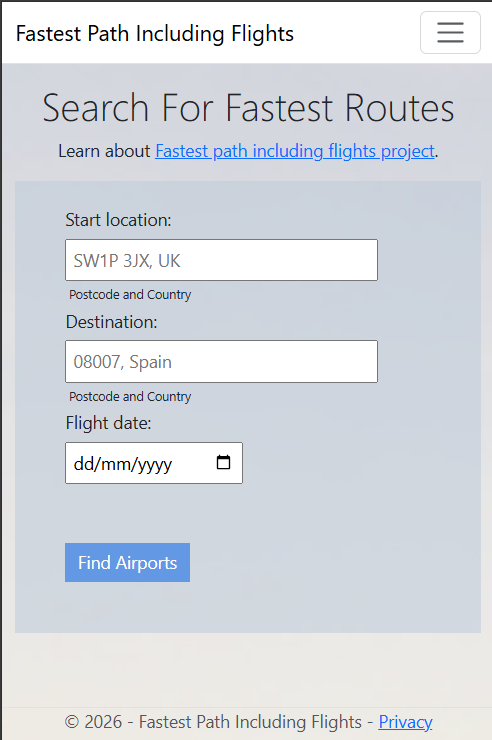
Fastest Path Including Flights research interface with starting location, destination, flight date and a Find Airports button
Project screenshot supplied by the developer. Sample locations illustrate the search interface; this showcase is not a live travel search or booking service.

THE RESEARCH QUESTION

Which journey is fastest
from start to finish?

The shortest flight is only one part of a journey. Travel to a departure airport, connections between flights and travel from the arrival airport all affect the overall route.

Fastest Path Including Flights is an independent research project developed for a friend. It explores combining those stages in one route-planning workflow.

THE TECHNICAL APPROACH

A simple search.
Several connected steps.

The supplied flow document describes an ASP.NET and C# application that works with airport coordinates, location lookups, ground-route information and a flight API.

The interface asks for a starting location, destination and flight date. Behind that form, the documented workflow identifies candidate airports, retrieves route and flight information, and compares candidate journeys.

DOCUMENTED WORKFLOW

From a postcode
to a set of possible routes.

  1. Locate the journey.

    Use the start and destination postcodes to request geographic coordinates.

  2. Find candidate airports.

    Compare coordinates against an airport CSV dataset and present nearby options for selection.

  3. Connect the ground legs.

    Request routes from the starting location to departure airports, and from arrival airports to the destination.

  4. Compare flight options.

    Retrieve flights for selected airport pairs and consider flight legs and connection waiting times.

  5. Present candidate routes.

    Show route options based on the chosen airports and the available information.

TECHNICAL CHALLENGES

Time, connections
and a wider search.

The flow document identifies indirect flights and waiting time between connections as calculation challenges. Different airport time zones also need to be accounted for when comparing journey durations.

It also considers whether travelling farther on the ground to catch a direct flight could be quicker than using a nearer airport with a connecting flight. Expanding the candidate airports creates more combinations to evaluate.

RESEARCH BOUNDARIES

A bounded comparison,
not a universal fastest-route claim.

The documented approach limits the nearby-airport shortlist to five to control API usage and calculation scope. It also uses large airports from the source dataset as its initial example.

Ground-route coverage, available flight data and the chosen airport shortlist constrain the comparison. The project explores candidate journeys within those limits; it does not establish that every possible route has been searched.

This case study describes the supplied interface and research workflow. It does not claim independently verified travel-time improvements, production availability or a flight-booking capability.
BEYOND STANDARD CONTENT PAGES

Have a workflow
worth exploring?

Discuss a development project ↗